China Letter 13 - Harbin - Beluga and Potatoes - Guo 过
2/6/26 - 2/9/26 Jin Ri Zi Du, Qingdao
Upon descent, the plane flew over a barren land, flat and pale, from either a great frost, dust or sand; clusters of buildings and brown rock-faces; there were dry riverbeds and cracks in the earth; then a massive lone highway and larger spreads of buildings with white roofs; then the sparse trees and more buildings, a swoop left, orderly lines in the land, as patches were cultivated for farming, a turn right, more rapid descent, sinuous swoops; then a distant city with cold peeling off of it like a white gas; buildings like hairs on an ice pig’s wart; over a frozen river, a rattling, five hundred feet over bare trees, cream colored houses, a kerplunk!, thuds, and soon we were waiting to collect our baggage from luggage belt 4.
Of course, the tarmac workers took some time to shift our baggage onto the belt from under the plane, since it was minus 24 C or minus 11 F, that bright morning in Harbin. After a highway, with lines of trees standing on either side, and an ice sculpture, in a roundabout, where there was also snowmen in red hats and red scarfs, the cabby drove down an avenue, XinYangLu. I thought the apartment buildings looked older than apartments in Qingdao. This could have just been the European architecture that is common in Harbin; for another thing, the apartments stood right aside the avenue and not in separate complexes, which suggested people moving from home to the streets to participate in the cold crossings of busy roads, wearing various types of coats, a shorter distance to the action. Harbin became a city in 1898, and Qingdao was established as a city in 1891. They became identifiable as places with tall buildings, roads, and other signs of social function at about the same time.
When I got in the cab, I had told the cabby,
“Please look at the address.”
The heat in the cab was off when I got in. The temperature rose as we drove.
“The address is in the A P P,” he reassured me.
“Yes, but it’s in English here.”
I wanted to make sure that the address translated correctly. The cabby recognized the “7 Days” of where I booked a room: 7 Days Harbin Central Street Hotel, Sophia Church Branch. Tourists and Harbiners moved slowly on the avenue, following their white breaths. Then we cut through downtown. The cabby pointed and said,
“There.”
I said,
“Here.”
And he said,
“No, there.”
I was pleasantly surprised when I walked into the warm lobby of a very nice hotel, and then surprised again when the boy working at the desk led me outside and pointed to the hotel next door. They had carpeted the outside steps of the 7 Days hotel. The entrance wasn’t facing the street but could be entered from the right of a glass room that protruded from the building-front. The lobby was small; only eight chairs. A family was at the desk. A lady, who I avoided because she seemed mystical, sat at a small desk to offer information and packages concerning tourist attractions. There was a fish tank, before the elevator, with two coy fish; one was colored like a pearl, and the other was orange and black. The man at the front desk gave me the card key to room 423.
The lobby lady rose up and intercepted my walk to the elevator to say,
“We’ll go together to the Ice and Snow World. I’ll give you a discount.”
“Bu Yao,” I said. “No want.”
I went up the one, often full, elevator, down a hall, and found my room. 423 didn’t have a window, nor was there a single drawer in the room, but there was a nice queen bed, a bathroom, a desk, and it was warm.
After unpacking my bag and stacking clean clothes on a flat surface, I went back in the lone elevator, to the lobby, and asked the lady,
“Church? Which way is the church?”
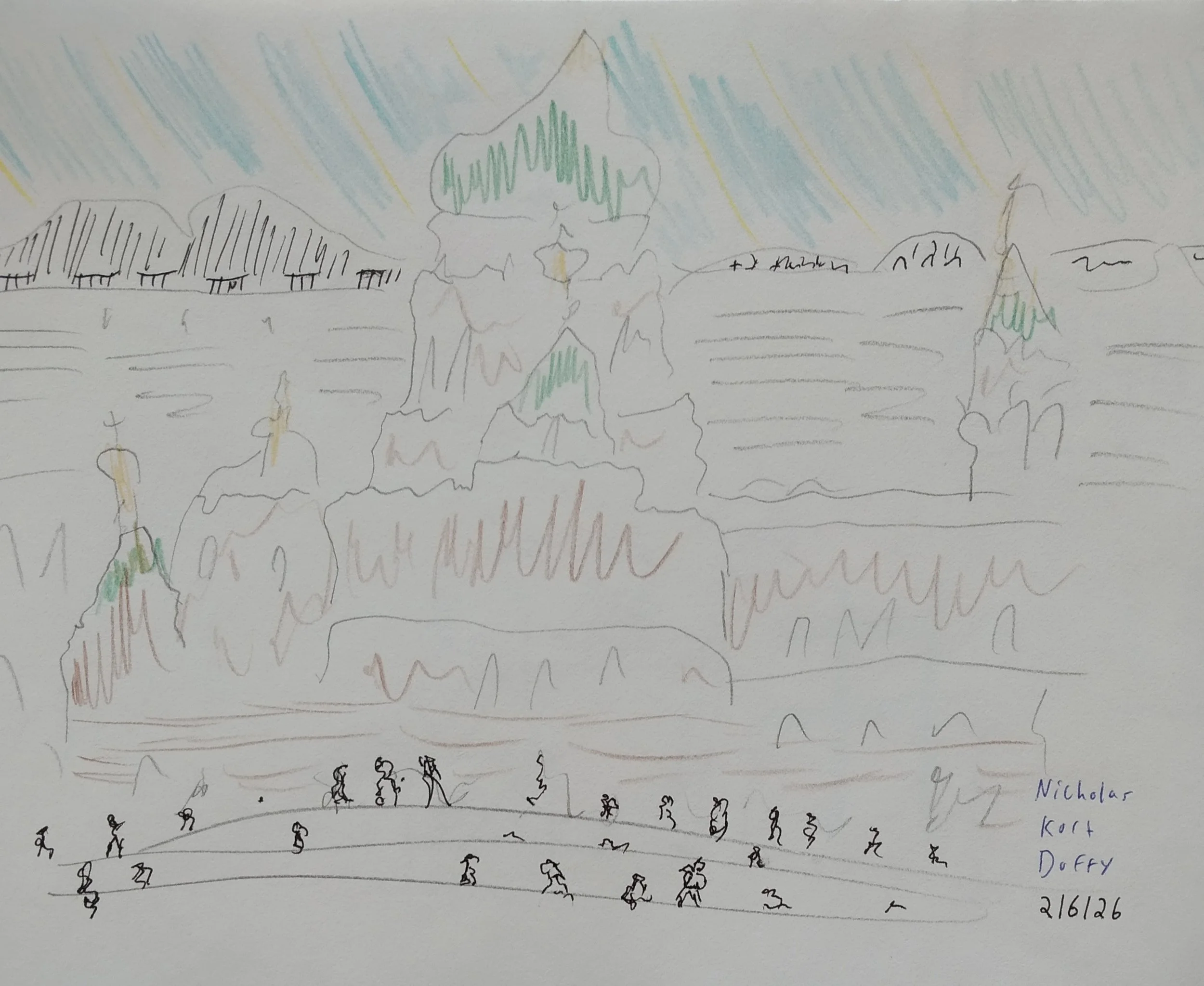
I pointed, and she confirmed which way to go. I went outside, down the carpeted stairs, and started to walk toward so many people who exhaled white breaths. There was a steel arch, between two buildings, to the left of the nearest avenue. Through the arch was the square with Saint Sophia Cathedral in the middle. Young ladies wore dresses with wide skirts, their hair done up with rhinestones, and white makeup, or they wore feathered wings and their mothers may have dressed up as well. They wanted photos with the church. Others were stationed at the perimeter of the square, facing their phones set on tripods and carrying on monologues with the church at their backs. I sat down on a concrete lip and drew a picture, in a manner that factored in the subzero cold. The cathedral is capped by a central onion dome and rectangular pyramids on spires that are all dark green. These statures are capped by gold orthodox crosses. Below is the brickwork, which is ornate, and lines of bricks divide the foundation. It is a most rigid beauty, like the last upright look at a contortionist before they plant themselves on the ground and angle their bones.
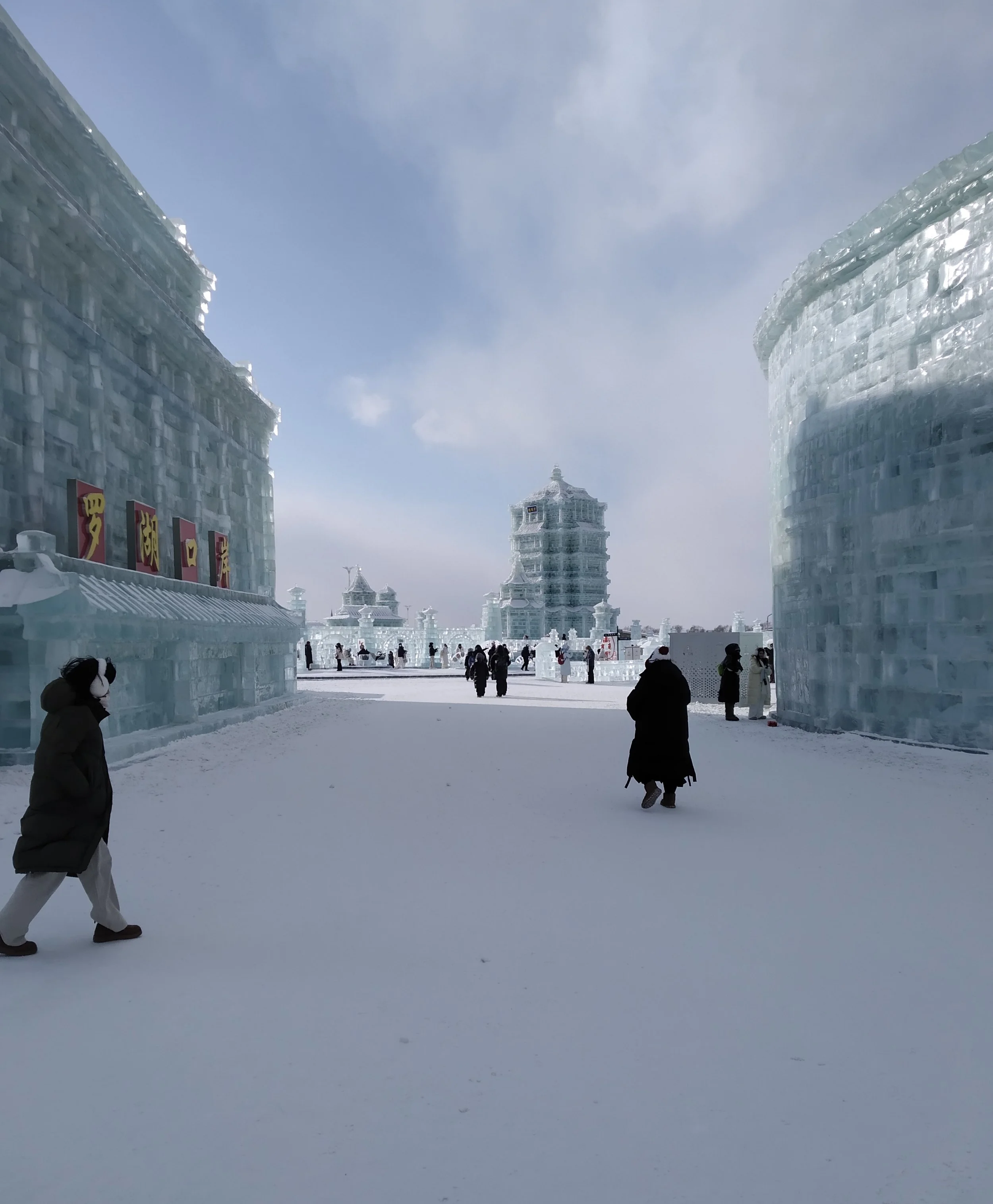
I bought a ticket to go inside the church, which had been converted into a music hall. It had been built by Russians in 1907, restored, then repurposed, at some point. Sunlight was reflecting off the narrow windows encased with ornate brickwork. There was only a short line to get inside Saint Sophia Cathedral. Inside, a man played a piano, on a stage, in place of the altar. A rendition of Da Vinci’s, Last Supper, attracted my studious eyes. Columns had paintings of saints. There was a general chatter. Stars were painted above gold chandeliers.
Afterward, I went to the “Manhattan” food court, by the square. I settled on having spicy noodles with beef, from a mom and pop restaurant. The biggest entertainment in Harbin was the cold itself. Sitting inside was to prepare for another excursion into it, to rejoin the procession of penguins. Plenty of flecks of tissue paper stuck below my nose then fell off. I wore a gray scarf, a fleece, my winter jacket, two pairs of pants, wool socks, sneakers, and gloves. I had my noodles in a cup.
Harbin was one of the first places that resonated with me, when I researched teaching in China, in 2019, because of the Harbin Ice Festival. It is easy to be curious when you find pictures of the ice sculptures online. Big smooth faces of beings. Thematic homages. Life-size buildings. Replicas of the actual city by ice. Although it was enticing to see the sculptures at night, when they would be lit up, red or blue or like rainbows, I went then. Around one o’clock that Friday, I returned to my room, meandering so that I was aware of landmarks. Unsure, I got my passport. Then I went out to look for the metro, having heard the Ice and Snow World has its own stop. No tangible directions were found in an underground mall. Then I noticed there was a sign for the metro by the church, and I found the Shangzhi Street stop.
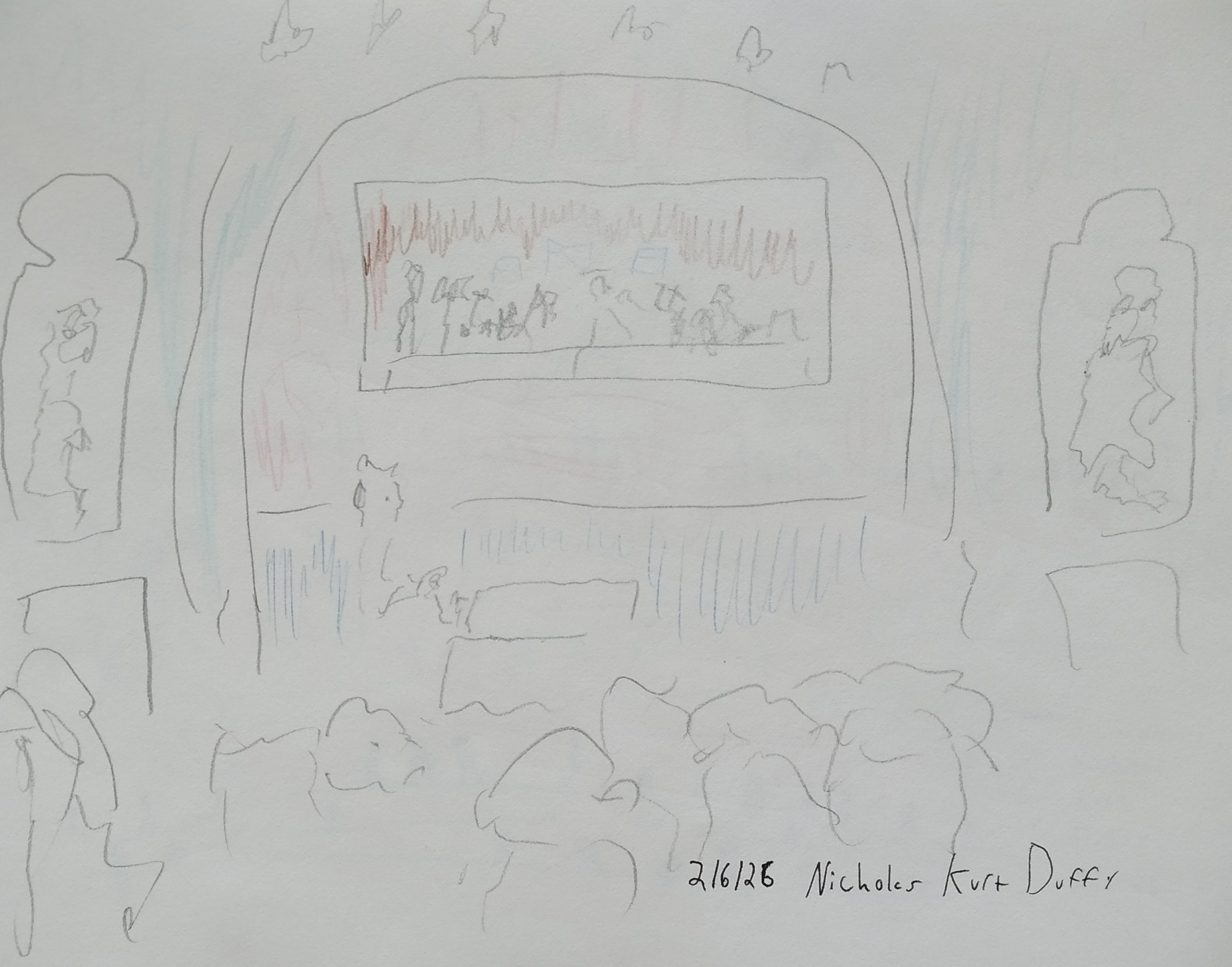
The metro system in Harbin is one yellow line, in the shape of a pentagon, with two other lines running through it. I was only four stops from the Ice and Snow World. When I surfaced, there was an ice replica of the Harbin Railway Station, frozen under the blue sky, as if surviving an ice age, with people wandering toward it to inspect. Like the majority of sculptures, the railway station was made of ice bricks, eight times the size of regular clay bricks. Certainly, the ice bricks were much heavier. All of the sculptures looked very heavy. I bought my ticket, which required a passport, and I went forward, excited to behold the spectacle with my own eyes. I stepped onto the snow covered plane, where forms of ice reached from behind one another with ridges, domes, towers, and facial features in the air. There was a white Ferris wheel, twinkling in the distance.
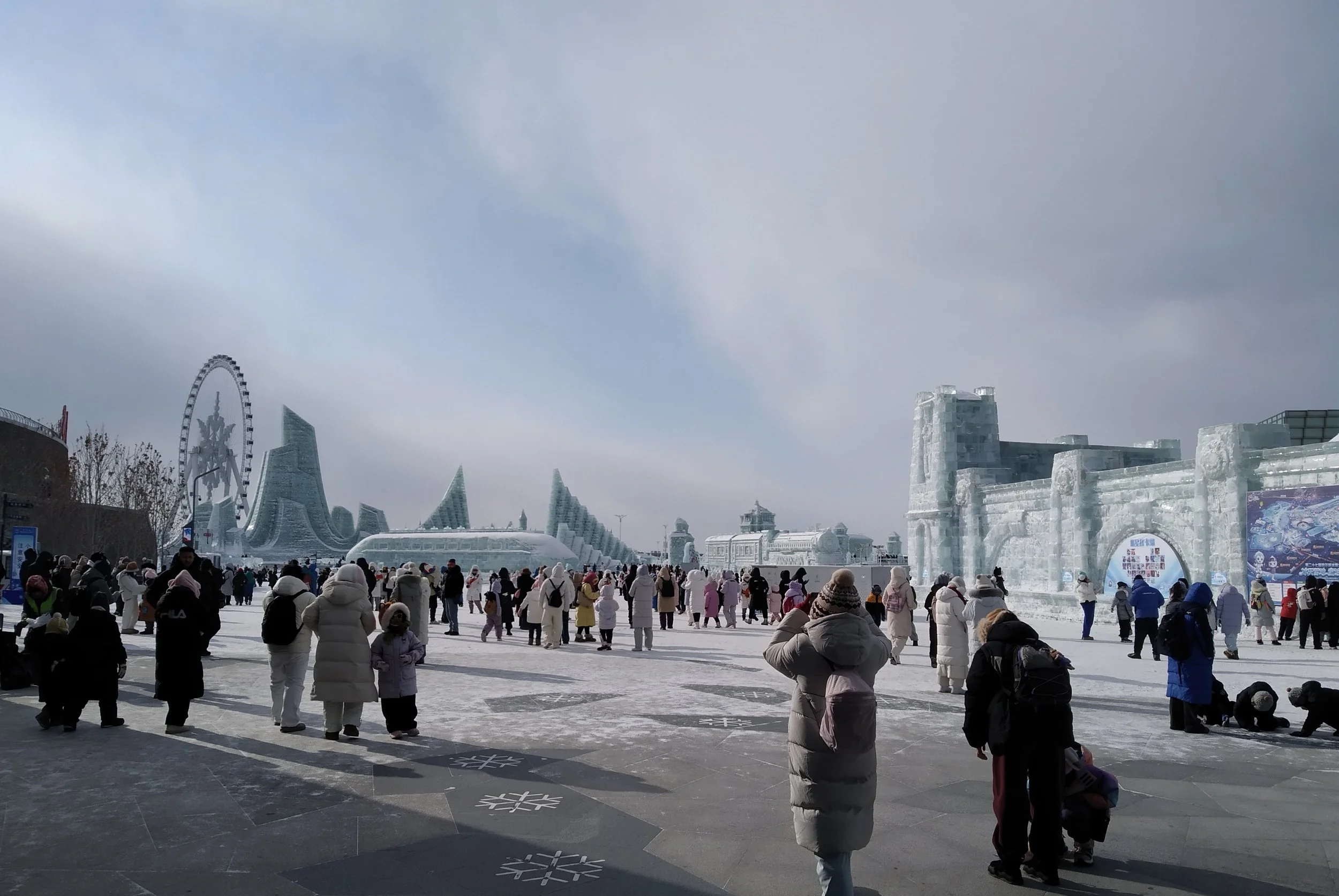
Little ones in snowsuits waddled forth or were pulled on rented tubes. A boy tried to pull his father on a tube. There was a life-size steam engine, carved with rods, pistons, and wheels. Parallel was a sleeker electric train. I waddled up the steps of a castle, careful to put my feet on the ice steps covered in snow, and looked out to see all the glimmering ridges. Children waited in line for an ice slide down. I waddled back down the stairs. I sought out some humungous, smooth-faced deity that sat by a wall. Over its shoulders, there was a procession, along one of the major walls that enclosed the park, in order to use the tallest slide. Minor ice walls sequestered other works. There were rows of smaller sculptures, craved from single blocks of ice: a beetle caught in a spider web, a dragonfly, monsters. These seemed more novice, as if part of a student exhibition. Artists from all over the world go to Harbin to carve.
There was a theater, where a drama ran every two hours. The actors and story were reminiscent of pagan inhabitants, who lived in the Heilongjiang province, as far back as two thousand years. An acrobat hung from the ceiling by a ribbon; there was a love story between a hunter and princess, who rode huge mechanical horses, in humorous slow motion. There was a feathered shaman, whose face you never saw. The shaman was always wandering around the perimeter of the stage gravely, while others danced together.
Content, I found my way back to the metro, and returned to the Shangzhi road stop. I got some supplies: water, sandals for the shower, a comb I had forgotten, and three bags of chips. I had another bowl of noodles and a pork sandwich by the hotel, at a chain restaurant. When I sat in the room that night, I wondered if I would be able to sleep well, or if the room would be too stuffy and I’d wake up more congested than I already was. The walls were thin. I could hear families laughing or solving problems in the hall. I put on the television and channel surfed for a bit. And when I slept that night, I slept so heavily! I dreamt 555 dreams in that warm room, that remained dark.
Saturday, I was determined to have coffee at the Corner Cafe, in the cathedral square, so I might add some details to my drawing. I got there a few minutes before the cafe opened and waited by the door. The cafe was upstairs from a gift shop. I sat in a green leather seat, did some work, and then I was headed to the next big attraction in Harbin: The Siberian Tiger Park. There, visitors ride trollies through a sanctuary. They can feed tigers chunks of meat with mechanical arms. Do we put two and two together when it comes to Siberian tigers, who live in the cold? It seems we are preoccupied with polar bears. What creatures. The Tiger Park didn’t look too far away when I checked, but, by rule, everything is farther away than it looks in China. I finally noticed the taxi was waiting in a line of sluggish traffic only .6 miles away from the destination.
I waved with my hand and urged,
“Go around!”
The cabby said something. I told him I was leaving and opened the cab door to get out and walk. I was a stone’s throw away from the start of a lane that led to the Tiger Park. Hundreds of people, bundled up and wearing all sorts of hats, were filtering down this snowy road, while cars waited in unmoving lines in the middle. There were many illustrations of tigers on signs and tiger statues. I followed the crowd in my two pairs of pants. The ticket kiosk was by a warming tent and a corral, where hundreds more waited in a line to go see the tigers. As I waited to buy my ticket, person after person crossed through the ticket line, directly in front of me, like I was a human bridge, and I didn’t mind that because it’s useful to not be stressed out by invasions of personal space. Perhaps, I was a source of warmth. When I got my ticket, I paid a little extra so I could feed the tigers meat. I went into a tent and ordered a sweet potato that I held and ate as I walked, pleased to have both breakfast and a hand warmer. The start of the line to see the tigers did not begin in the corral but much farther back, around a skating rink, and by a miniature zoo. At that point, I noticed there was a tiger nursery, and other animals, in pens, by the start of the line. I also concluded upon what I’d been considering; I wasn’t going to keep waiting to see these tigers. There were too many people, and I’d visited tigers several months ago, in Huangdao.
The less populated, miniature zoo had no line at all. I first saw alpacas with googly eyes, like Emperor Kuzco. There were alarming Wagheji sheep, from Afghanistan, with large hooked noses and bulging ears, which can weigh up to 300 pounds. In the nursery, there were two tanks. In the first, a striped tiger cub gnawed on the ear of a lion cub. They both had such large paws! There was another tiger cub in there and two more in the second tank. I saw tigers and was content. Soon enough I was waiting by the highway for a taxi. It was a woman driver, which I don’t see as much, and she brought me to Heilongjiang Museum of Nationalities. In each building of a repurposed confucian temple, there was an exhibit with relics or other evidence for peoples, who had been in the area from two thousand years ago till now. The original inhabitants had fish skin boots and deer skin pants! When the buildings functioned as a temple, each building had a different ceremonious purpose. One building was dedicated to the veneration of sages; the number of sages fluctuating over the years. Public officials, who were considered to be stand up citizens, were remembered in the confucian temple, as examples of good conduct, for future generations.
The courtyard was empty and bright. Only a dozen or so others explored the red buildings. A particular blue color scheme, almost floral, was consistently painted on the eves and ceilings, above the different displays of materials, clothes, papers, and photos.
By the road, a soldier assisted a laborer to move a ladder so that he could climb and hang a red lantern on the archway. I glanced quickly to make sure they were both wearing gloves.
The next cabby was listening to a book on tape. I went back by the church and caught a double decker, hop on hop off bus, which took me, for the first time, down Central Street. We drove by Red Street, historically a Russian neighborhood, named red after the color of the roofs. The audio recording played as we drove. Harbin is “a city of details” and “the music capital of the world.” The tour bus audio also claimed the first piano was invented there. These claims were erroneous, if you look on a search engine, which claims Austin, Texas is the music capital of the world. This is a good example of the fluidity of trivial knowledge. For this reason, principles are far more important for longevity than certain tiers of knowledge, as these involve practice, time, and basis. As Confucius said,
“There are some with whom we may study in common, but we shall find them unable to go along with us to principles. Perhaps we may go along with them to principles, but we shall find them unable to get established in those along with us. Or if we may get so established along with them, we shall find them unable to weigh occurring events along with us,” (Tsze Han, Legge, 312, 314).
The bus moved about the city without as much hassle as the cars stuck in traffic. It drove over the Sanri river, toward Sun Island and the Ice and Snow World. I didn’t get off at the science museum, for, at that point, the praise of the audio recording made me skeptical of any historical claims. The hop on hop off bus was a great way to see the lay of the city and stay out of the cold. Wanting to see Central Street more closely, I got off by a park nearby, saw more ice sculptures through the fence, then turned and found the sign for Zhongyang Dajie. I smelled myself around a chocolate museum. Hmmped at a chocolate version of The Scream. There was a pine green and gold sign down a street depicting a dish I like. The green and gold aesthetic tends to indicate Sino - Russian cuisine. The dish I like is fried pork, lightly breaded, and served with a honey sauce, like Duck Sauce. I went up the stairs, saw a long hallway, a waiting room, and a dining room, as well as rooms like dining carts. The restaurant’s capacity, I’d estimate, was 500 people. I got a number to wait then went down a hall to check out the fish tanks. There were many more international people in Harbin due to the festival and other reasons, I’m sure. But it’s ironic because, in a perfect world, it doesn’t matter what people look like or where they’re from, so you, in theory, shouldn’t get excited or surprised when seeing someone who might have been born in the other hemisphere. You just walk by, and let what you might have said dissolve into worldly maturity.
When I sat down in the waiting section, a woman approached me and asked,
“Where are you from?”
“I live in Qingdao,” I said.
“Why did you choose to come to China?”
“Good pay for a teacher and good food.”
“Why come here?”
“It looked like a good restaurant.”
When I got to my table and saw the menu, I was interested, perhaps very interested, in trying the beluga and potatoes, along with the fried pork dish I had been anticipating. I ordered both dinners. I’d only eaten a sweet potato that day, after all. Waiting, I started to doubt I could eat two dinners, then the big plate of fried pork was brought out. Each bite of the crispy pork with sweet honey sauce did not disappoint. I started to think there was hope. If it was possible to eat two dinners, it would depend on how delicious the beluga and potatoes tasted. The second plate came. The potatoes were not cut in cubes, like in the picture, but in longer chunks. I took a bite and found this second dish was also yummy. I had an aversion to the skin of the beluga, so I didn’t eat those pieces. I made a meteoric impact on the two plates of food.
All the while, I trusted the many families around me were having a good meal. Then the lady who I spoke to in the waiting area came to my table. She turned out to be a journalist. She wanted to record my commentary on the restaurant (you get used to these kinds of things). Herself and a waitress put their cameras on me and said, “Go.”
In Chinese, I said, “I saw these, and I wanted these. Good food.”
Then I said some English. The restaurant was called, Lao Chu Jia.
Later, in a cafe, above the street, I got a lemon and blueberry tea. That place was called 1922 cafe. Afterward, Central Street was illuminated by electric lighting, and I discovered a book store! Close to the hotel, I’d seen two bookstores that had both been closed. The first floor displayed the Chinese or translated bestsellers. I admired the covers. There’s a popular book right now called, Salty Joke. Not sure what it’s about. On the third floor, there were books in English. I bought two books of translated Chinese poetry, selected poems of Du Fu and Lu Xun, and, The Story of Chinese Philosophy. I walked through a bustling mall, then I went to bed.
On the third day, Sunday, I traveled by metro to attend church. There were two, on the side of a road, when I surfaced from the underground. The stop was for Harbin Hospital. I went into the church, where people were proceeding through the doors, around 8AM, and I was showed upstairs to the second floor, which was isolated from the first floor, a separate room. A screen was used to broadcast the mass in multiple rooms. It began like a sing along. Eight songs played back to back, their lyrics showed on the screen, in Hanzi. Then a man spoke, a chorus sang, and a very energetic and happy woman delivered an ecstatic sermon. She spoke for over forty minutes. She said, “Guo,” a lot, which means to pass.
“Guo Nian Hao” is Pass New Year Well.
On Central Street that morning, it was nice to find cobblestone, a more leisurely pace, and coffee. I sought the Old Synagogue, at the top of Red Street, and found it, eventually. That building, like Saint Sophia Cathedral, had also been converted into a music hall. I spent hours looking for a mug, from Central Street to the cathedral, but, whenever I asked, “Ni You Yi Ge Beizi Kafei Ma?” The clerks thought I was asking for a cup of coffee and not a cup for coffee. The mug proved to be a scarce souvenir. So I didn’t get one. I had a nice lunch with an orange, carbonated beverage and burped.