China Letter 16 - Cherry Pine - The Good Earth - Adult Content II
3/30/26 - Jin Ri Zi Du, Qingdao
Dear reader,
Line 11 is above ground. It is also called the Oceantec Valley Line. You course in the metro cabin, one hundred feet in the air, and, after the Science and Technology University, you glide by appealing dirt hills and fleeting vistas of villages. The line rides toward Jimo, a district where, my friend tells me, there is “nothing.” Two Saturdays ago, the 21st, I rode line 11 to the Beijiushui station and waited, by exit B, to join a group of hikers.
That was a sunny day. Three women soon arrived and confirmed they were part of the hiking group. We met up with two others, foreigners, making us six. Led by a good-spirited woman, D***a, we walked southward, along the highway, then began to explore a village. I was unsure where exactly we’d be hiking, as I’d never been to that area, only seen the hills from the metro. The hills above that village are terraced; so, for the first time, I was near the photogenic sight of orderly ridges. This agricultural technique of terraced hills originated in South America, according to my new colleague, I**s, who I asked later. She also gave me the lowdown on potatoes; potatoes and sunflowers were both brought to the United Kingdom from South America, in the 16th century, while explorers, accidentally, left behind plague.
As our band gradually walked uphill, aside many houses of concrete, there was a dilapidated cottage made of bricks. Our chatter was stopped by the honking of two geese, and a meet-and-greet, with a fluffy golden retriever, relaxing on a chain. Soon, we came to an avenue, which rose aside a gorge. We paused to look, over a wall, at the green scum and water of a river below. Children made arrangements with rocks on a bridge. They chucked the rocks into the river. To the east, after the river, there was another hill that would divide the village from the noise of highway.
Street lamps had coverings for the lightbulbs, shaped and colored like red cherries. It was too early in the season for harvesting, which is done in May, but that village specialized in growing cherries. We saw what is sought this time of year; a few cherry trees in bloom.
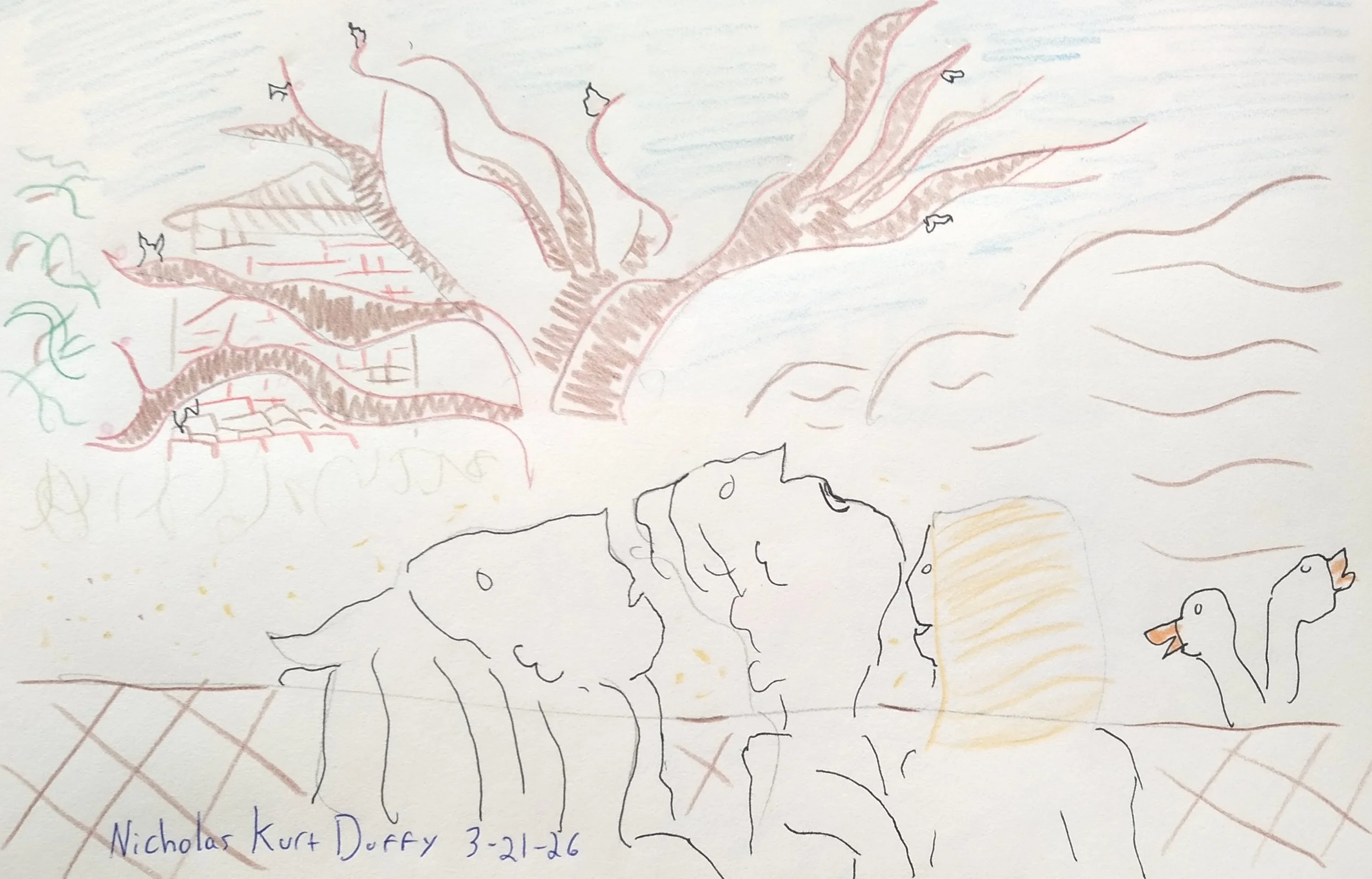
We began to ascend a hill, off the avenue. I could see the elevated metro line in the distance. We’d trekked about two miles already. Eventually, we came to a green fence that would have us not proceed further. Although D***a was leading the hike, another woman, in her thirties, with an almond shaped face, Carmen, was very outspoken, and she insisted that we continue passed the fence. Sure enough, Carmen tested a gate of the fence and it wasn’t locked.
(I use Carmen’s name here without censoring because that morning she climbed on top of a rock, while explaining,
“Yeah, I’m Carmen. You can call me No Carmen, because I don’t have a car, or a man.”)
We walked higher and found ourselves shrouded under pine trees. Carmen was thinking out loud a lot. Taking off on her own. A sprite of a woman. She quit her job months before, something I’ve heard many Chinese say, actually. We climbed higher into the pines, then sat down, and exchanged snacks; caramelized pretzels, egg tarts, peanuts, and oranges. Carmen played music. There was a teacher from the suburbs of “Chicahgo,” who had taught in Spain and Prague. I asked her about pizza. There was a young German man interning in a factory here. Earlier in the hike, Carmen had crouched down to have a pretend picnic, picking up rocks and calling them things, and the German had crouched down, and joined in, on the imaginary picnic.
After the pines, we returned to the avenue, beside the gorge, and walked for a half-hour toward a place to have lunch. There were signs of affluence, new cars, electric ones, to boot, and tall mansions. In Qingdao, cherry farming is quite a lucrative business, apparently. Another staple crop is the green tea grown in the Laoshan mountains. We reached the lunch destination and had a great meal outside. There was a hammock that I lay in, sketching. We had pork with cabbage, a two foot long river fish, and fried ginseng, which was an astonishingly seamless alternative to French fires, the fried ginseng was.
We hiked more later but were barred from certain routes. We climbed on the terraces for a while. Carmen had picked up a piece of brick to make a mark on a facade. When she asked what the name of our band was, I said, “Cherry Pine” and she added 666666. “6” being a lucky number, round these parts. Carmen inscribed our hiking group’s name on the wall outside the dilapidated cabin before we left, [Cherry Pine 6 etc].
Last Saturday, the 28th, there was the fifth meeting of my book club. For four meetings in a row, we’ve met at the same cafe. It’s in a line of businesses, on a very narrow lane, beside a wall put up for construction. Once I forgot my phone charger there, went back in the morning, and saw feats of parking being done as drivers backed into a sort of trench, between the curb and construction wall.
The outside of the cafe has a porch with handwritten scrolls of hanzi. There’s also a sign with Bukowski on it, promoting a poetry reading in 2023. Inside, the walls are covered in shelves with books. Some are in English. There are ornamental books hung like a rainbow toward the ceiling.
So far the book club has read, The Reckless Oath We Made, A Christmas Carol, Chronicle of a Blood Merchant, I Who Have Never Known Men, and, most recently, The Good Earth, by Pearl S. Buck. First of all, I’ve been learning a lot through listening to others’ interpretations of books. I especially enjoyed speaking about, Chronicle of a Blood Merchant, by Yu Hua, with a erudite Chinese man, C****n, who graduated from The University of Edinburgh as well.
Yu Hua’s work is a great threshold read if you want to get a notion of modern Chinese literature, which is far more critical, relatable, and brilliant than any ‘oriental’ notion.
The book club has showed me that some books are indeed just escapes, and, if you read these, chronically, you would be hurting your own understanding, perhaps. Though, if that’s your stuff, it’s for the glee of entertainment. Not all reading is reading, would be the tagline of an essay on this subject.
What I realize comfortably in the last few days is that I am ignorant. I was really sure The Good Earth was a sort of dramatic appropriation, despite the fact it won a Pulitzer Prize, for fiction, in 1932. It woos with images of foot-binding and opulent decorations and concubines and simple farmers without teeth. The book is set from 1882 - 1939, at the fall of the Qing dynasty and beginning of the revolutionary period. I thought the characters were too simple to stand for a representation of “China.” Their peasant life is meek but also convenient for a story. I knew my opinion was obviously insubstantial considering the readership the book has attracted. And Pearl S. Buck lived in China for over forty years. What’s more, I was shut up before I began, when, C****n, said he felt the book was very “real.”
He said, “When I read this, I was amazed that it wasn’t written by a Chinese person.”
“It’s easy to judge the morality of Wang Lung, a simple farmer, in today’s age, when things come easier and we have convenience.”
He agreed with the popular consensus that The Good Earth showed sides of Chinese life that Chinese, at the time, would not admit. What’s more, it’s a historically accurate portrayal of a farmer, living after the fall of the last dynasty, when men were forced to grow out their hair and have long ponytails. Marriage and women were thought of as a means to gain property, by many.
H****e added, “But that’s how it was all over, not just China.”
All and all, it was relieving, but humbling, to learn that this book was accurate, from the perspective of a Chinese friend. It’s not other things. The Good Earth is not objective journalism. It’s not China today, as I’m experiencing it. But the author chose a particular perspective to see China in, that of a peasant, a character that made an accessible story.
There is a lawless aspect to the society the characters live in. The protagonist, Wang Lung, fears marauding robbers. I asked about this lawlessness and was informed, “That’s how it was.”
What I can infer is that current means of policing here have effectively stopped much crime and made China safer, but it has not always been the safe and surveilled country we know it is today. This is kind of obvious, but that doesn’t mean the current state of things can’t be appreciated, while people balance new-found wealth, food, technology, vehicles, construction projects, and, dare I say, peace.
Regarding the section of my last letter, Adult Content, I would like to nip something in the bud. When we talk about ‘everything,’ including other people, we run into the danger of being misunderstood; the ugly thing is to say that people can’t and shouldn’t be as they are. The best ‘reality’ is participatory and involves making sense with others. There’s a certain level of dialogue that is so caught in abstraction that when one speaks of it, they seem to be wanting control, and I don’t mean to say that there isn’t pluralism, that is, multiples sides.
What I am getting at, as an artist and man, a month away from age 34, is a worldview that I can explore and make intelligible through fiction, and will do it that way. In short, I submit, can we start to view the technologies we use as the cause of our frustration rather than others to then focus our use of technology to appreciate our lives and work together better? Can we be happier and healthier together, everyone?
It is ugly to talk about some issues in general, but, by using abstraction, by doing things, in good taste, educated perspective can be communicated.
Isn’t it the teacher’s challenge to have knowledge they want others to have, too?
The thing is, people can be as dumb as they want. That’s, perhaps, always going to be an option. It will also be an option to blame others, and to subscribe to newfangled ideologies in place of study, and who wants anyone to spend a life facing problems that have already been solved in a different historical context?
What I think students need to study the humanities today is sense-depravation.
There are unlimited things I could write, on several aspects of what I see to be the obstruction to a better order in America, but, because my thought is current and developing, and you, too, are thinking about today, it’s best, like it always is, to practice what I preach.
I read recently that ‘literature is a vehicle for ideas.’ I gather these days that what I mean can only be expressed by continuing to make the work I do, and that is how my point will thrive, by giving books, valleys and hills, as well as a grasping at the participatory thing.
No matter how brainy and sure one gets, it’s awesome to see someone who stands at the wrong side of the train waiting for the doors to open while they open behind them, their hair a mess, half-asleep.
Today was Palm Sunday. At St. Michael’s, the clergy left out branches of pine, in place of palms.
Keep learning.
Best,
Nick
To reply, email: nicholasthepoodlebooks@outlook.com